

Detect YouTube ads, mute YouTube audio, and control Spotify Web Player during ad breaks.
Github
https://github.com/maxmakhk/youtube-ad-spotify-bridge
What I built:
• AI agent that reads industrial equipment displays via computer vision
• Real-time gauge extraction and health status validation
• Web interface with camera capture and file upload
• Runs locally on GPU using Florence-2 vision model
• Deployed via Cloudflare Tunnel for remote access
Tech Stack:
Python | Flask | Florence-2 | PyTorch | CUDA | JavaScript | Cloudflare Tunnel
Features:
✅ Dynamic OCR parsing (adapts to any equipment)
✅ Automated health-check with threshold validation
✅ Structured JSON output from raw display images
✅ Mobile-responsive web UI
✅ 2-3 second analysis time per image
Architecture:
Local GPU → Florence-2 Model → Flask API → Web Interface
Github: https://github.com/maxmakhk/aiagent
Live Demo: https://aiagent.maxsolo.co.uk
Demo Server not Always Online 🙄
#Python #AI #ComputerVision #Flask #MachineLearning

An online tool built with React that calculates company income and estimated after‑tax income from monthly, daily, or hourly rates, making it easy for solo contractors to handle their accounting.
Built a React-based dashboard for monitoring sterilization equipment temperature/pressure in real time (internal industrial tool).
Build creations using freeform components (beams, joints, walls), AI Review—no fixed steps, pure creativity to meet goals!

controls quests and actions on platforms via visual drag-and-drop scripting.

designs the 3D world map, enabling automatic item and object placement like trees and buildings.
Usage Impact
Use Case
Survival game placement often feels clunky—misaligned or unplaceable. Built a 2D-driven snap system for fluid, intuitive control. Rare (or unseen) in titles I’ve played.
Design
- Free Drag: Screen-space mouse offset moves object (camera-aligned), skips raycasting.
- Range Filter: Center distance < 2 units; ignores far objects.
- 2D Snap: Project snap points to screen, match via < 20px distance.
- Feedback: Live red line + red sphere (position locked until release).
Place: Mouse-up snaps (or grid fallback) + overlap check.
[Flow]
- Down: Grab snap points → 2D positions.
- Move: Nearby targets → 2D → highlight closest.
- Up: Snap & lock.
Only nearby objects processed—lean & fast.
- Application
Powering my upcoming Three.js survival-builder. Modular bases, resource flow. Precise, frustration-free building. Watch this space.
After 6 months of solo development, I am excited to share my JavaScript-based Open World Survival Crafting game, designed for lightweight 3D story-driven projects.
Key features include:
- Smooth player controls and open-world exploration
- Full building system – craft tools, bases, and structures
- Dynamic quest system with progression and narrative
Technologies used:
- Three.js for 3D rendering
- PixiJS for 2D UI/HUD
- Ammo.js for realistic physics
Next steps involve adding visual polish, sound, and delivering a fully playable version on Steam.
Last week, I started working with 3D models and animations.
However, it's completely not my strength. I spent the whole week dealing with rigging and format issues.
When comparing it to 2D artwork, 2D is too slow and inefficient. The main problem is that it's difficult to reuse materials, especially animations. So, I believe I need to master 3D animation skills for game creation.
Traveling Merchant: A Cozy Medieval Trade Adventure Nears Completion!
Medieval commercial economic system, Dynamic NPC, trust mechanism...
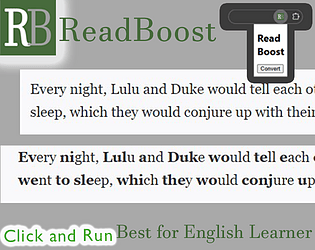
It automatically splits words into syllables and makes them more readable, helping users to focus on important parts of the text. Perfect for language learners or anyone who wants to improve text readability without altering the original content style.

Game Includes:
Type: Card Game
Language: English, Chinese, Japanese
9 Endings
Card game with Animations
New Game keep creating every week, please give me your comments!😎
Free Play on itch
https://lnkd.in/ee8meqH4
Monster Huner @ Wild Cats?? 😼
🛠 Build & Modify: Assemble mechanical bodies, swap parts, customize colors.
🎮 Edit Animations: Adjust movement & fine-tune actions.
🔧 Repair & Calibration: Fix damaged units, optimize performance.
💀 Inspired by: Cyberpunk 2077 Ripperdocs, Battle Angel Alita Dr. Ido.
🚀 Early Build – No gameplay yet, feedback shapes next updates!
Play on Itch.io
https://lnkd.in/e5DbMjKP
Traveling Merchant is a 2D mobile game where you step into the shoes of a wandering merchant. As you journey through various towns, you'll meet new friends who become your trusted customers.
As your wealth grows, you'll unlock access to more distant towns and cities, expanding your network of friends and opportunities in your quest to become the most successful traveling merchant.


I'm starting a new mobile app project to create a fitness app using React Native. I will record all parts of the process, including coding, design, and planning, without any cuts.
This is just the start, and I expect to finish it in a few days. I will also release a web version and an APK for Android.

I enjoy creating game animations using SpinePro, but it has some limitations, such as separating parts, rotating components, resizing textures, and redrawing. Additionally, handling physics, mass in relation to the world, and creating an easy-to-read JSON format can be challenging. To address these issues, I developed a custom tool with basic functionality. While it's not as advanced as Spine2D and doesn't create smooth human animations, it's ideal for animating robots, monsters, or large bosses in its current version.

There are many visual game editors like Unity, Unreal, Godot, and RPG Maker. However, for my project, I needed to create a game with multiple cities, which would require a lot of effort to build each scene individually. To streamline the process, I developed a custom map editor specifically for my needs. After creating this tool, my workflow became much faster and more efficient!

This project integrates a chatbot into a React Native mobile app. It features a loading cover page, an NPC list, and a conversation page that connects to a Node.js backend for managing conversations. Additionally, it showcases a 3D character model rendered using Three.js.
For prototyping, I enjoyed using React.js with its vast library ecosystem, but for production, React Native proves to be more stable and offers better performance for mobile development.

Front-End/Full Stack developer
Over 15 years of building Full Stack Web projects end-to-end
One year of UK commercial experience
New Business Structure
Business → AI Product Manager → AI Consultant ↔ AI Engineer + Data Scientist + MLOps Engineer

Contact me on Linkedin
Linkedin https://www.linkedin.com/in/maxmak5511/
Address Manchester

 Commercial